Washington: In a significant shakeup of his foreign policy team, U.S. President Donald Trump announced two key appointments: Secretary of State Marco Rubio will temporarily serve as the interim National Security Advisor, while former National Security Advisor Mike Waltz has been nominated to represent the United States as the Ambassador to the United Nations.
The announcement comes amid growing scrutiny over Waltz’s recent conduct. Just weeks ago, reports emerged that Waltz had invited a journalist into a Signal chat used for discussions on sensitive military operations. The controversy was followed by confirmation that both Waltz and his deputy, Alex Wong, were stepping down from their posts.
Despite this, Trump expressed strong confidence in Waltz, stating on social media:
“Mike Waltz has worked tirelessly to prioritise our nation’s interests since his time in uniform on the battlefield, in Congress, and as my National Security Advisor. I am happy to declare that Mike Waltz will be my choice to be the next ambassador of the United States to the United Nations.”
Waltz’s nomination will now move to the Senate for confirmation, where he is expected to face questions over the Signal incident and his handling of intelligence.
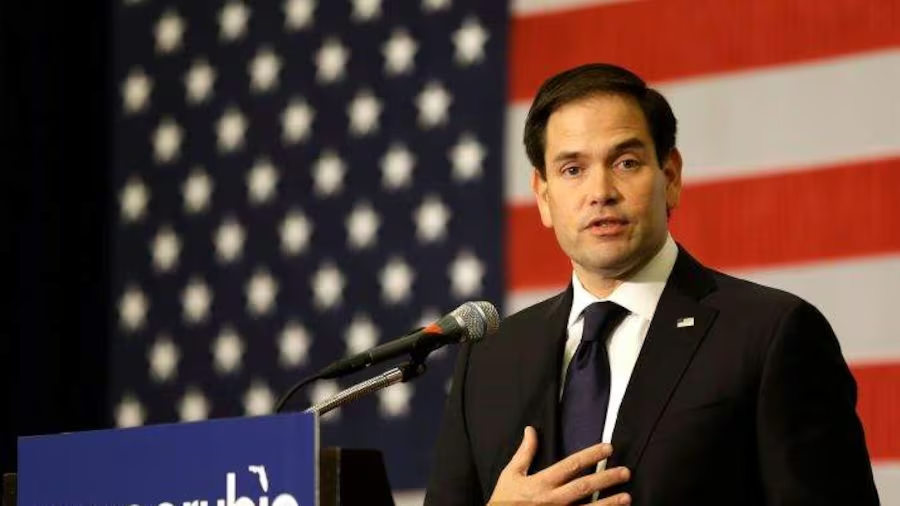
In the interim, Marco Rubio will take on dual responsibilities—continuing as Secretary of State while stepping in as National Security Advisor until a permanent appointment is made.

“While maintaining his capable leadership at the State Department, Secretary of State Marco Rubio will act as National Security Advisor in the meantime,” Trump added. “We will keep fighting together to make America and the world safe once again.”
This move is seen as part of Trump’s broader strategy to consolidate leadership in key areas of U.S. foreign policy as tensions continue to rise in multiple regions, including the Middle East and South Asia.
Political analysts note that Rubio’s expanded role underscores Trump’s trust in the Florida senator, who has remained a vocal ally and played a pivotal role in shaping U.S. diplomatic policy in the current administration.
The appointments mark another high-profile shift in Trump’s national security team, reflecting ongoing realignments as the administration responds to global conflicts, intelligence leaks, and challenges to American diplomatic standing.